
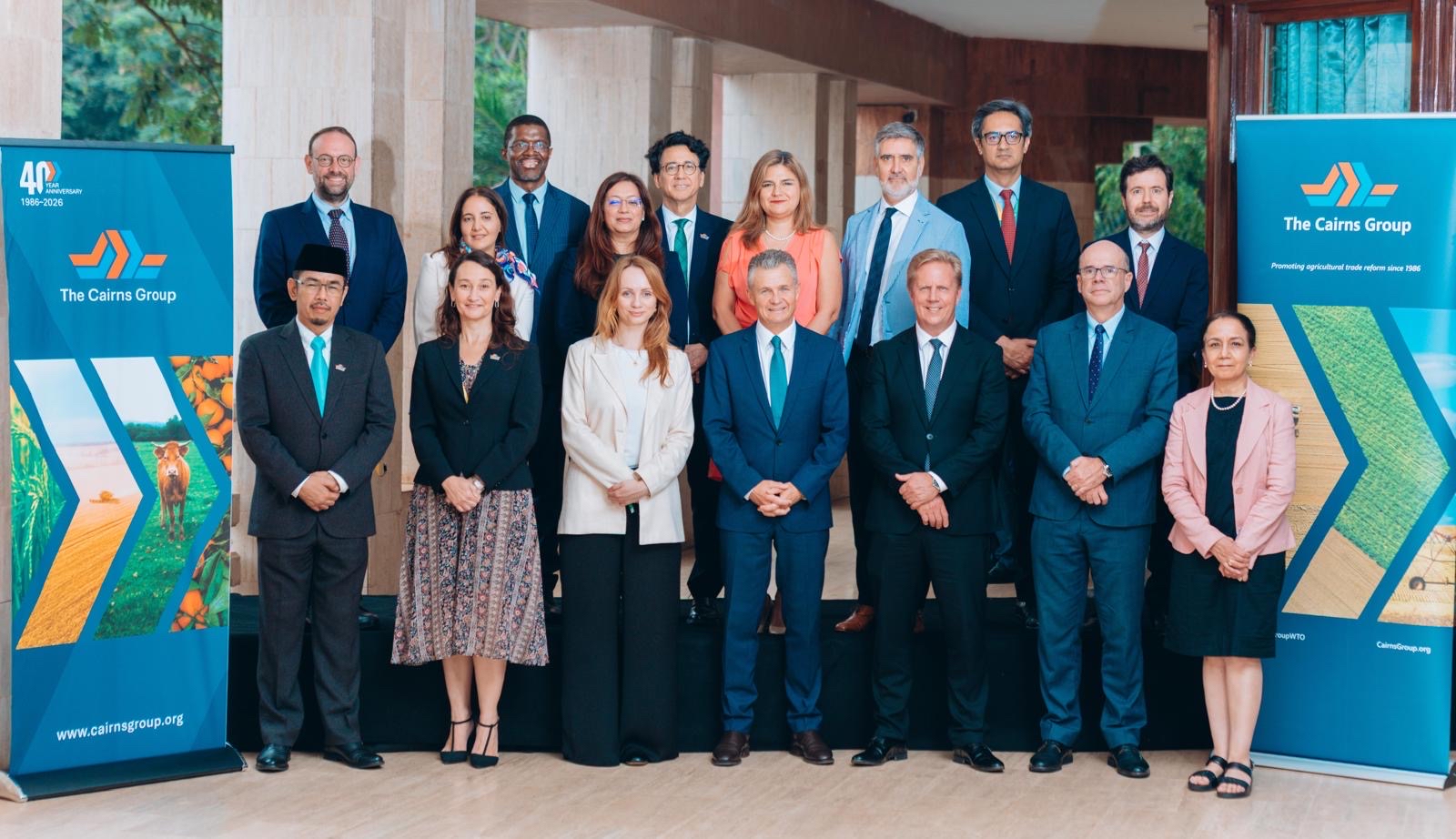

Statement of the 45th Cairns Group Ministerial Meeting
Yaoundé, Cameroon
25 March 2026
- We, the Ministers of the Cairns Group,1 met in Yaoundé on 25 March, marking the Group’s fortieth Anniversary and at a time of critical challenges in international trade.
- The Cairns Group recognised ongoing tensions in the global trading system and the challenges and uncertainties this is creating. The Cairns Group discussed the impacts that tariff and non-tariff measures have had on agricultural markets and trade. It emphasised the importance and value of economic stability derived from predictable agricultural markets.
- We underscore that agriculture trade reform remains critically important unfinished business of the WTO negotiations. Such reform would help improve economic conditions of our agriculture sectors, and advance global and national goals on development, livelihoods, food security, equality and economic, social and environmental sustainability. Fairness cannot be fully addressed at the WTO without improving the current Agriculture rulebook. Agriculture reform should be addressed at the WTO’s Fourteenth Ministerial Conference (MC14).
- Agricultural trade continues to be affected by measures that distort trade and production, including subsidies, tariffs and other barriers. The Cairns Group reaffirmed our enduring commitment to achieving greater fairness and a levelling of the playing field in agriculture through ambitious and comprehensive agricultural trade reform. We reaffirm our commitment to making progress across all pillars and topics of the agricultural reform process, in accordance with Article 20 and the Preamble of the Agreement on Agriculture and subsequent Ministerial Decisions and Declarations on agriculture with a view to ensuring a balanced and progressive reform process.
- Within the context of members’ rights and obligations under WTO provisions, we reaffirm our view that economic development is an important element of the multilateral trading system and that agricultural trade reform is essential to support the individual economic development needs of developing Members.
- We recognise that innovation, technology, and productivity gains are key to building a competitive and sustainable agricultural sector. We emphasize promoting innovative technologies, research and development, and capacity-building—especially for small and medium-sized producers—to enhance productivity, resilience, integration into global markets, and to support food security and sustainable development.
- We emphasise that different Members have unique agricultural production circumstances, and there is not a ‘one-size fits all’ approach for improving sustainability outcomes. We remain concerned about the impact on agriculture and WTO-consistency of environmental trade-related measures undertaken by some WTO Members. These measures must be necessary and must not be designed for protectionist purposes and not amount to unjustified trade restrictions, impose excessive compliance costs, or constitute a means of arbitrary or unjustifiable discrimination. We are also concerned with support and protection policies that are harmful to the environment and we underscore that market-oriented reforms would support a transition to a more sustainable global agriculture system.
- We believe the WTO must be an effective forum for examining trade and production effects of emerging agricultural trade issues, ensuring open and inclusive deliberations, with a view to supporting well-functioning agricultural markets.
- The Cairns Group remains committed to working with other WTO Members and Groups to advance agricultural trade reform. We have consistently invested in efforts to build convergence across all pillars and topics, placing emphasis on frank and open discussions to better understand Members’ diverse circumstances and priorities, while exploring creative approaches. Drawing on our past engagements and looking forward to future work, we underscore the importance of Member-led, inclusive, and transparent discussions informed by sound data and evidence. We also reiterate our commitment to engage with industry and farm associations including Cairns Group Farm Leaders to ensure the voices of all farmers are heard at the WTO.
- As the Cairns Group enters its 40th year, we looked back on the group’s achievements. We recalled that in a challenging negotiating process, the Cairns Group successfully pushed for the inclusion of new agricultural trade rules to reform global agricultural trade during the Uruguay Round negotiations under the General Agreement on Tariffs and Trade. From the creation of the WTO to the present, the Cairns Group has continued to be a strong and constant voice for agricultural reform.
- It is regrettable that the WTO has failed to reach any substantive reform outcome in agriculture since 10th WTO Ministerial Conference in 2015. On the eve of MC14, the Cairns Group reminds all WTO Members that agricultural reform lies at the centre of a strong multilateral rules-based trading system. A reversal of commitments achieved since the Uruguay Round would be unacceptable and inconsistent with Article 20 mandate. Achieving meaningful progress in agricultural negotiations will require a renewed commitment from all Members to engage constructively and explore flexible approaches.
- We call on all Members to unite in efforts to take forward multilateral negotiations on agriculture post MC14, with a view to taking decisive steps towards the fifteenth Ministerial Conference.
[1] Argentina, Australia, Brazil, Canada, Chile, Colombia, Costa Rica, Indonesia, Malaysia, New Zealand, Peru, the Philippines, South Africa, Thailand, Ukraine, Uruguay, Vietnam